
Ozone & Hyaluronic Acid for Knee Osteoarthritis: Benefits, Evidence & Treatment

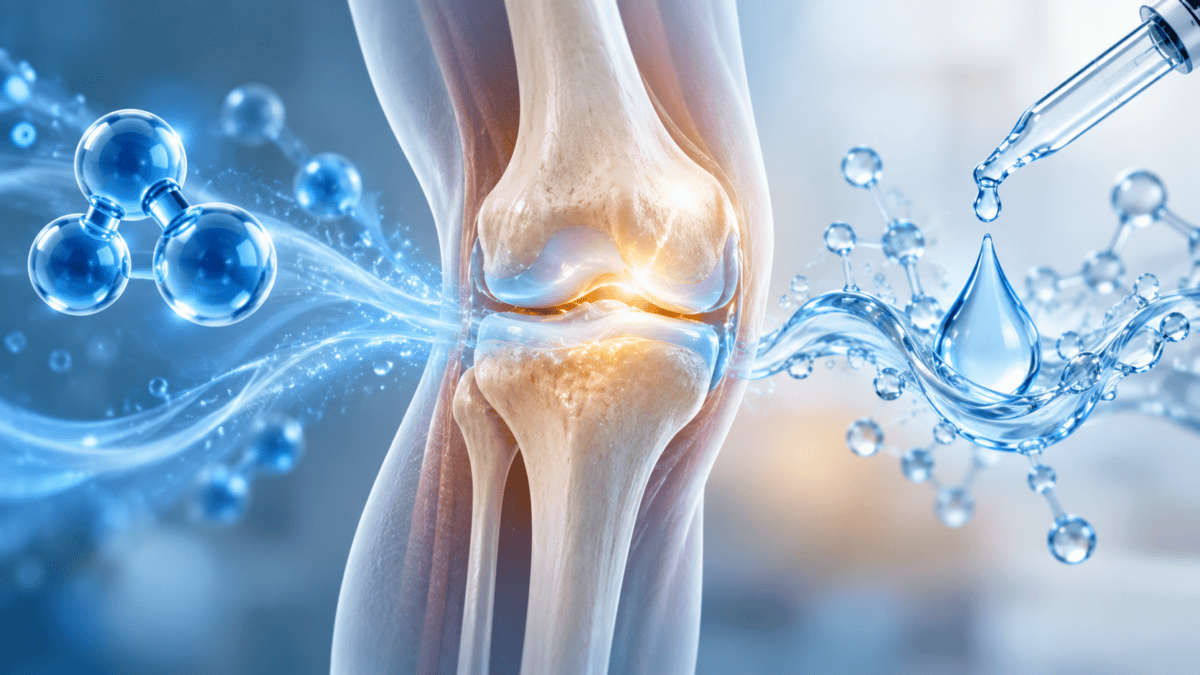
Synergistic Effect of Ozone and Hyaluronic Acid in Osteoarthritis of the Knee
Knee osteoarthritis is a progressive condition associated with pain, stiffness, inflammation and changes in the joint environment. In daily practice, patients usually describe a fairly predictable pattern: pain while walking or climbing stairs, stiffness after sitting for some time, difficulty with prolonged standing and gradual reduction in their normal activity.
Knee preservation has therefore become an important part of modern osteoarthritis management, particularly when treatment is started before advanced structural damage develops. We use a combination of Oxygen-Ozone and High Molecular Weight Hyaluronic Acid (HA) as part of our multimodal “Ludhiana – Protocol” for knee preservation. These two have different properties, and their combination has been studied specifically in knee osteoarthritis.
Why Combine Ozone and Hyaluronic Acid?
Hyaluronic Acid is a natural component of synovial fluid. It contributes to the lubrication and viscoelastic properties of the knee and helps maintain the normal environment in which the joint moves. Oxygen-Ozone has a different biological role. Intra-articular ozone has been investigated for its anti-inflammatory, immunomodulatory and pain-modulating effects, with clinical studies reporting improvement in pain and function in knee osteoarthritis.[1][2]
What Has the Research Shown?
The first important evidence for the combination came from a randomized study by Giombini et al. in 2016. Seventy patients with knee osteoarthritis were divided into three groups receiving HA, Oxygen-Ozone or a combination of both. All three groups improved, but the combined-treatment group showed significantly better outcomes for pain, symptoms, activities of daily living and quality of life, particularly at the two-month follow-up.[3]
The 2018 randomized clinical trial by Raeissadat et al. included 174 patients with chronic knee pain or swelling and imaging-confirmed osteoarthritis. Patients received either three weekly HA injections or three weekly Oxygen-Ozone injections. Both groups showed significant improvement in pain, stiffness and function at six months, with no significant difference between the two treatments.[4] This study is useful because it shows that ozone and HA can each provide clinical benefit, but neither treatment should automatically be considered superior to the other in every patient.
More recent evidence has added another dimension. A 2025 retrospective comparative study by Latini et al. evaluated 84 patients receiving Ozone, HA or the combination. The combination produced advantages in several functional and quality-of-life measures, including WOMAC physical function, total WOMAC, Knee Society Scores and both physical and mental quality-of-life scores. The authors also observed a difference in the timing of benefit: ozone provided earlier pain relief, while HA was associated with more sustained improvement.[5]
Another randomized clinical trial published in 2025 by Akhavanakbari et al. compared HA alone with Ozone + HA in 60 patients. Both groups improved, but the combination group had a greater reduction in pain at six months, along with greater improvement in health-related quality of life and sleep quality.[6] A newer 2026 randomized controlled trial by Sconza et al. compared intra-articular Oxygen-Ozone with HA in 112 patients. Both treatments produced significant improvement from the first month. Ozone appeared to act faster, whereas the HA group showed greater pain and functional improvement from three months onwards.[7]
Taken together, these studies provide a more useful clinical picture. Ozone may provide an earlier symptomatic response, HA may have a more sustained effect, and combining the two may provide complementary benefits in selected patients.
How We Use the Combination
At Dr. N. K. Aggarwal Joints & Spine Centre, Ludhiana, the combination of Oxygen-Ozone and High Molecular Weight HA is used as part of our multimodal knee-preservation approach. We assess the patient’s symptoms, clinical examination, X-rays or MRI, severity of arthritis and mechanical alignment before deciding the treatment. The patient’s activity level and general health also matter.
Ozone is used as an adjuvant for its pain-relieving, anti-inflammatory and immunomodulatory properties, while HA provides the lubricating component. Depending on the condition of the knee, the combination may be incorporated with other complementary modalities such as PRP/Growth Factor Concentrate, joint lavage and correction of abnormal mechanical loading. The sequence is individualized. There is no single injection schedule that suits every knee.
Who May Be Considered?
This approach is mainly considered when knee preservation remains a reasonable clinical objective. Patients with mild to moderate osteoarthritis or early structural disease may be managed differently from those with severe bone-on-bone arthritis, major deformity or extensive structural damage. Age by itself does not decide treatment. We look at the condition of the knee, the patient’s symptoms and how much those symptoms are affecting daily life.
Ozone + HA Within the Ludhiana Protocol
The combination of Oxygen-Ozone and High Molecular Weight Hyaluronic Acid forms one component of Dr. N. K. Aggarwal’s “Ludhiana Protocol for Multimodal Knee Preservation.” The idea is to use complementary local and biological treatments according to what the individual knee requires. Ozone and HA can be used together, with PRP/GFC, lavage or mechanical correction added when clinically indicated.
For a patient sitting in front of us with knee pain, the question is not simply which injection is better. We need to determine what is driving the symptoms, how advanced the structural disease is, and whether the knee is still suitable for a preservation-oriented treatment pathway.
Medical References
[1] Lino VTS, et al. Efficacy and safety of ozone therapy for knee osteoarthritis: an umbrella review. Frontiers in Physiology. 2024;15:1348028.
PubMed: https://pubmed.ncbi.nlm.nih.gov/38444768/
[2] Raeissadat SA, et al. Intra-articular ozone or hyaluronic acid injection in knee osteoarthritis: a 6-month randomized clinical trial. Journal of Pain Research. 2018;11:111-117.
PubMed: https://pubmed.ncbi.nlm.nih.gov/29379312/
[3] Giombini A, et al. Hyaluronic acid, oxygen-ozone, and their combination in knee osteoarthritis. Journal of Biological Regulators and Homeostatic Agents. 2016;30(2):621-625.
PubMed: https://pubmed.ncbi.nlm.nih.gov/27358159/
ResearchGate: https://www.researchgate.net/publication/311605201_Comparison_between_intrarticular_injection_of_hyaluronic_acid_oxygen_ozone_and_the_combination_of_both_in_the_treatment_of_knee_osteoarthrosis
[4] Raeissadat SA, et al. Intra-articular ozone or hyaluronic acid injection: Which one is superior in patients with knee osteoarthritis? Journal of Pain Research. 2018;11:111-117.
PubMed: https://pubmed.ncbi.nlm.nih.gov/29379312/
[5] Latini E, Nusca SM, Curci ER, et al. Ozone and hyaluronic acid, alone and in combination: exploring temporal dynamics and synergies in intraarticular therapy for knee osteoarthritis. Pain Physician. 2025;28(4):347-357.
PubMed: https://pubmed.ncbi.nlm.nih.gov/40773642/
Article: https://www.painphysicianjournal.com/current/pdf?article=ODAzNg%3D%3D&journal=171
[6] Akhavanakbari G, Asayeshi M, Noktehsanj R, Aslani MR. Comparing the efficacy of combining ozone therapy with hyaluronic acid versus using hyaluronic acid alone for pain relief in patients with knee osteoarthritis: a randomized clinical trial. Complementary Therapies in Medicine. 2025;93:103238.
ScienceDirect: https://www.sciencedirect.com/science/article/pii/S096522992500113X
[7] Sconza C, Parente A, Marotta N, et al. Intra-articular injections of oxygen-ozone versus hyaluronic acid for the treatment of knee osteoarthritis: a randomized controlled trial. Journal of Back and Musculoskeletal Rehabilitation. 2026;39(1):216-227.
PubMed: https://pubmed.ncbi.nlm.nih.gov/40660843/

