
Sports Injury Treatment in Ludhiana: ACL, Meniscus, Rotator Cuff and More

Sports Injury Treatment in Ludhiana: ACL, Meniscus, Rotator Cuff and More
A sudden twist of the knee. A sharp pain in the shoulder during a gym session. A hamstring that tightens halfway through a sprint.
Sports injuries can happen to professional athletes, weekend players and people who exercise to stay fit. Some involve temporary muscle strain, while others damage ligaments, tendons or cartilage and require a more structured treatment plan.
The important question is not just how to relieve the pain, but whether the injured tissue can recover with rehabilitation or needs further intervention.
Sports injury treatment depends on the type of injury, its severity, the person’s activity level and the demands they want to return to. Options may include activity modification, physiotherapy, growth-factor-based treatments in selected cases, arthroscopic surgery and a progressive rehabilitation programme. [1,2]
For people looking for an orthopaedic surgeon in Ludhiana, understanding these options can help them make informed decisions about diagnosis, recovery and returning to sport.
What Is a Sports Injury?
A sports injury is damage to a muscle, tendon, ligament, bone, joint or other tissue that occurs during exercise or physical activity. It may happen suddenly following a fall, collision or awkward movement, or develop gradually from repetitive loading.
Sports injuries are commonly divided into two categories.
Acute injuries occur suddenly. Examples include an ACL tear during a change of direction, an ankle sprain after landing awkwardly or a muscle tear during sprinting.
Overuse injuries develop when repetitive stress exceeds the body’s ability to recover. Tendon problems, such as some forms of rotator cuff tendinopathy, may develop this way.
Pain, swelling, bruising, weakness and reduced movement are common symptoms. However, symptoms alone cannot reliably determine whether an injury is a minor strain or a significant structural tear. [1]
Common Types of Sports Injuries
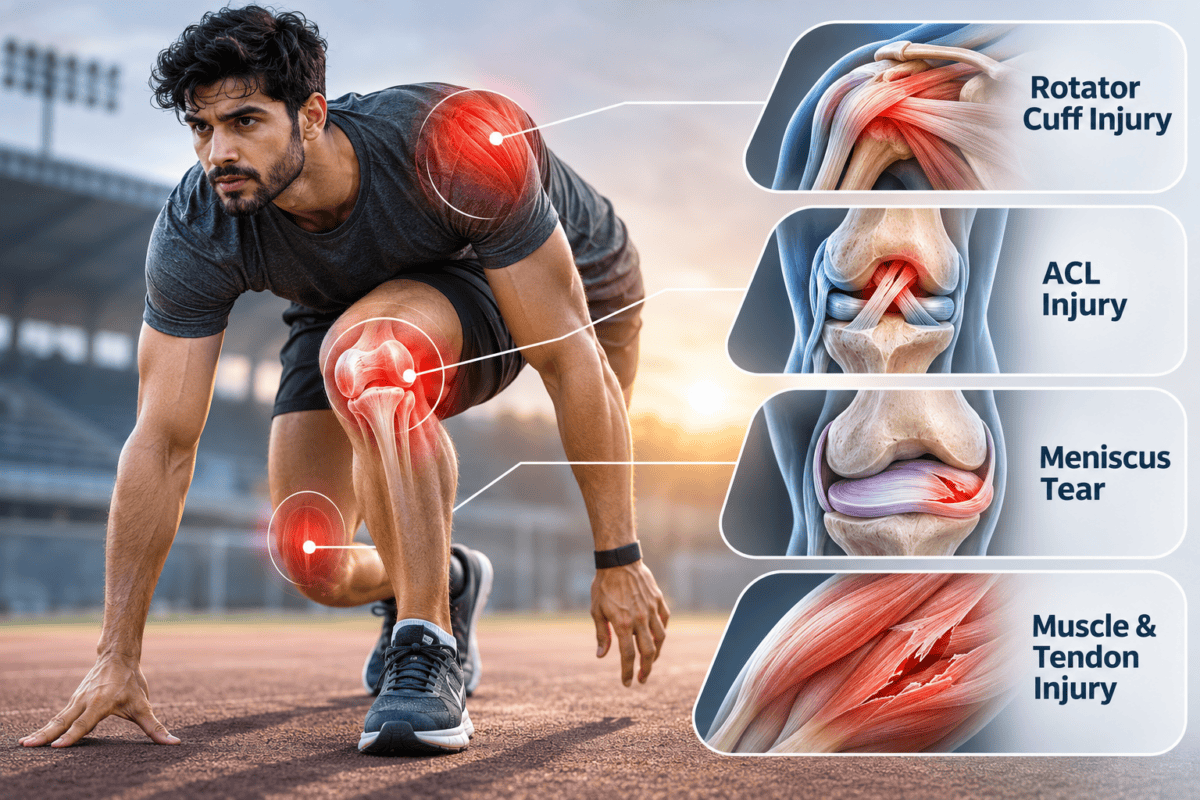
1. Ligament Injuries: When a Joint Loses Stability
Ligaments connect bones and help stabilize joints. They may stretch or tear when a joint twists, bends beyond its usual range or experiences sudden force.
The knee is particularly vulnerable to ligament injuries during football, basketball, badminton and other activities involving rapid turns, jumping and sudden stops.
Symptoms may include swelling, pain, difficulty bearing weight and a feeling that the joint is giving way.
The severity of the injury matters. Some ligament injuries respond to rehabilitation and appropriate support, while complete tears involving significant joint instability may require surgical assessment. The treatment decision depends on the specific ligament, associated injuries and the person’s activity requirements. [2]
2. ACL Injury: Why Knee Stability Matters
The anterior cruciate ligament (ACL) is one of the major stabilising ligaments inside the knee. It helps control forward movement and rotation of the tibia relative to the femur.
An ACL injury may occur when a person suddenly changes direction, lands awkwardly from a jump or stops abruptly. Some people notice a popping sensation followed by swelling and difficulty continuing the activity.
An ACL tear does not automatically mean surgery is necessary. Treatment depends on the degree of instability, associated meniscus or cartilage injuries, activity goals and response to rehabilitation.
For some patients, structured rehabilitation may be appropriate. For others, particularly those with persistent instability who want to return to sports involving pivoting and rapid direction changes, ACL reconstruction may be considered. Rehabilitation is essential whether treatment is surgical or non-surgical. [2]
3. Meniscus Tears: More Than Just Knee Pain
The menisci are two crescent-shaped pieces of cartilage inside the knee that help distribute load and contribute to joint stability.
A meniscus tear can occur when the knee twists under load, particularly during sports. Tears may also develop gradually as the tissue changes with age.
Symptoms can include pain along the joint line, swelling, catching, difficulty bending the knee and, in some cases, locking. These symptoms can overlap with other knee problems, so examination is important.
Treatment depends on the tear’s location, pattern, size, associated injuries and the condition of the knee. Some tears improve with non-surgical management. When surgery is appropriate, the surgeon may consider repairing the meniscus or removing only the damaged portion that cannot be preserved. Meniscus preservation is often preferred when a repair is feasible because the meniscus helps protect the joint. [3,4]
4. Rotator Cuff Injuries: When Shoulder Movement Becomes Painful
The rotator cuff is a group of four muscles and their tendons that help move and stabilise the shoulder. These structures are important in swimming, throwing, weight training and other overhead activities.
Rotator cuff problems may develop gradually from repetitive loading or occur after a sudden injury.
Common symptoms include shoulder pain when lifting the arm, discomfort during overhead activity, pain at night and weakness when rotating or raising the arm.
Not every rotator cuff tear requires surgery. Treatment may include activity modification, appropriate medication, Orthobiologic treatments and physiotherapy. Surgical repair may be considered for selected patients, particularly when a significant acute tear causes weakness or when symptoms and functional limitations persist despite appropriate non-surgical care. [5]
5. Muscle and Tendon Injuries
Muscle strains occur when muscle fibres are overstretched or torn. They commonly affect the hamstrings, quadriceps and calf muscles.
Tendons connect muscles to bones and transmit the force needed for movement. Repetitive loading can cause tendon pain and reduced tolerance for activity, while a sudden force can sometimes produce a partial or complete tear.
Treatment varies with the injury. Minor strains may improve with protection, temporary activity modification and a gradual return to movement. More substantial injuries may require imaging, specialist assessment and a targeted rehabilitation programme. [1]
How Are Sports Injuries Diagnosed?
A sports injury assessment begins with understanding how the injury happened, where the pain is located and which movements are affected.
The examination may assess swelling, joint stability, range of motion, muscle strength, tenderness and the ability to bear weight.
Depending on the suspected injury, investigations may include:
X-rays: Help identify fractures and certain bone abnormalities.
MRI: Can provide detailed images of ligaments, menisci, tendons and other soft tissues.
Ultrasound: May help assess selected muscle and tendon injuries.
Other tests: May be needed when the symptoms suggest a different underlying problem.
Imaging is not necessary for every injury. It is selected according to the clinical findings and whether the result is likely to affect treatment. [2,3,5]
Sports Injury Treatment: Which Options Are Available?
There is no single treatment for all sports injuries. The appropriate approach depends on the injured structure, severity, functional demands and recovery goals.
1. Rehabilitation and Physiotherapy
Rehabilitation is central to recovery from many sports injuries. It aims to restore movement, strength, balance, coordination and the ability to tolerate sport-specific demands.
A programme may begin with controlling symptoms and restoring comfortable movement. It can then progress to strengthening, balance work, controlled loading, running drills and sport-specific exercises when appropriate.
Progression should be based on function and clinical assessment, not simply the number of days since injury. Returning to sport too early can increase the risk of reinjury.
2. Growth Factor and PRP Treatments
Platelet-rich plasma (PRP) is prepared from a patient’s own blood. It contains concentrated platelets and associated biological mediators, including growth factors involved in tissue repair processes.
PRP has been studied for selected tendon problems and other musculoskeletal conditions. However, evidence varies by injury type, preparation method and treatment protocol. Treatment recommendations must be specific to the condition rather than based on general claims about growth factors. [5,6] PRP may be discussed for selected patients after an appropriate assessment, with a clear explanation of the evidence, limitations, alternatives and costs.
3. Arthroscopy: Treating Certain Injuries Through Small Incisions
Arthroscopy is a surgical technique in which a surgeon uses a small camera and specialised instruments inserted through small incisions to examine and treat problems inside a joint.
It may be used for selected ACL injuries, meniscus tears and some shoulder conditions, including rotator cuff injuries.
The procedure depends on the diagnosis. ACL reconstruction involves restoring ligament function, while meniscus surgery may involve repairing the torn tissue or removing a limited damaged portion when repair is unsuitable. Some rotator cuff tears can be repaired arthroscopically.
Arthroscopy is not automatically the best option for every sports injury. The decision should consider the injury pattern, likely benefits, surgical risks and expected rehabilitation requirements. [2,3,5]
4. Return-to-Sport Planning
Being pain-free does not always mean an athlete is ready to return to full activity.
Depending on the injury, assessment may include strength, range of motion, balance, movement control, endurance and the ability to perform sport-specific tasks safely.
A gradual return may begin with controlled training before progressing to unrestricted practice and competition. The timeline differs between injuries and individuals, particularly after ligament reconstruction or tendon repair.
When Should You Seek Medical Assessment?
Arrange a prompt assessment if you have significant swelling, persistent pain, repeated joint instability or difficulty returning to normal activity.
Seek urgent medical attention if an injury causes severe pain, an obvious deformity, numbness, a cold or discoloured limb, or an inability to bear weight. A joint that becomes hot and swollen with fever also requires urgent evaluation. [1]
Do not attempt to play through an injury when the joint feels unstable or the pain is worsening.
Sports Injury Treatment in Ludhiana
The right sports injury treatment starts with identifying what has been injured and how severely. A muscle strain, ACL tear, meniscus injury and rotator cuff tear can produce overlapping symptoms but may require very different treatment plans.
At N K Aggarwal Joints & Spine Centre, Ludhiana, assessment by an orthopaedic specialist can help determine whether an injury is suitable for non-surgical management, structured rehabilitation, a selected growth-factor-based treatment or arthroscopic surgery.
The goal is to restore function, support a safe return to activity and reduce the risk of further injury. Treatment decisions should be based on the individual’s diagnosis, clinical findings and activity goals rather than a one-size-fits-all protocol.
If pain, swelling, weakness or instability is preventing you from exercising or playing sport, consider an assessment with an orthopaedic surgeon in Ludhiana to discuss the appropriate next steps.
References
- National Health Service (NHS). Sprains and strains. Available at: https://www.nhs.uk/conditions/sprains-and-strains/
- American Academy of Orthopaedic Surgeons (AAOS). Management of Anterior Cruciate Ligament (ACL) Injuries: Clinical Practice Guideline. Available at: https://new.aaos.org/quality/quality-programs/anterior-cruciate-ligament-injuries/
- American Academy of Orthopaedic Surgeons (AAOS). Management of Acute Isolated Meniscal Pathology: Clinical Practice Guideline. Available at: https://new.aaos.org/quality/quality-programs/acute-isolated-meniscal-pathology/
- American Academy of Orthopaedic Surgeons (AAOS), OrthoInfo. Meniscus Tears. Available at: https://orthoinfo.aaos.org/en/diseases–conditions/meniscus-tears/
- American Academy of Orthopaedic Surgeons (AAOS). Management of Rotator Cuff Injuries: Clinical Practice Guideline. Available at: https://www.aaos.org/quality/quality-programs/rotator-cuff/
- American Academy of Orthopaedic Surgeons (AAOS), OrthoInfo. Rotator Cuff Tears. Available at: https://orthoinfo.aaos.org/en/diseases–conditions/rotator-cuff-tears/