
AVN of Hip: Can You Avoid Surgery?

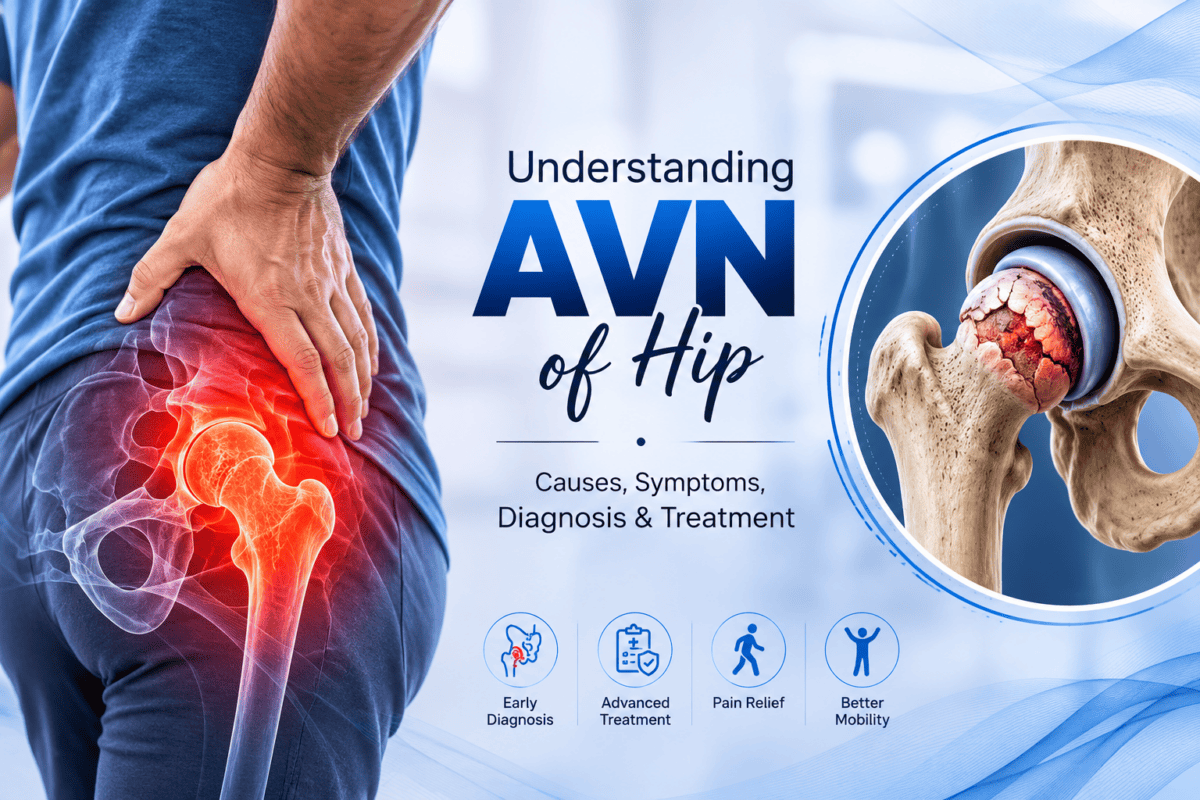
AVN of Hip: Can You Avoid Surgery?
If you’ve been diagnosed with Avascular Necrosis (AVN) of the hip, your biggest concern is probably: “Can it be treated without surgery?”
The answer is yes – but only if AVN is diagnosed in its early stages, before acetabulum also gets invoved. Early treatment may reduce pain, improve hip function, and delay disease progression in selected patients.[1][2]
Who Can Be Treated Without Surgery?
Non-operative treatment may be suitable if:
● AVN is in an early stage.[1]
● MRI shows a small affected area.[2]
● Pain is mild to moderate.
● Daily activities are not grossly restricted.
Your orthopedic surgeon will decide the best treatment after reviewing your MRI and clinical examination.
Non-Surgical Treatment Options
1. Activity Modification
Reducing stress on the hip is the first step. Avoid running, jumping, prolonged standing, and other high-impact activities. Using a walking stick or crutches may reduce pressure on the affected hip.[2]
2. Medications
Pain-relieving medicines can help control symptoms. In selected early-stage patients, bisphosphonates may delay disease progression, although results vary and treatment should be individualized.[3][4]
3. Physiotherapy
A supervised physiotherapy program can improve hip movement, strengthen muscles, and make walking easier. However, physiotherapy cannot regenerate dead bone.[2]
4. Hyperbaric Oxygen and Ozone Therapy
HBOT may improve oxygen delivery to the affected bone and has shown encouraging results in some early-stage patients. However, current evidence is not strong enough for it to be considered standard treatment for everyone.[1][5]
5. Extracorporeal Shock Wave Therapy (ESWT)
Some studies suggest ESWT may reduce pain and improve hip function in early AVN. More high-quality research is still needed before it can be routinely recommended.[1]
6. Orthobiologics & Regenerative medicine
Recent studies have suggested very promising results with Orthobiologic and regenerative treatment methods. It can effectively reduce pain, improve function and postpone or even help avoid the need for major surgical intervention like Total Hip Replacement.
Can AVN Heal Without Surgery?
Unfortunately, dead bone does not completely regenerate on its own. The aim of conservative treatment is to relieve pain, preserve the hip joint, and delay the need for surgery.[1][2] Multimodal treatment combining some of above modalities can have synergistic effects and further improve the results of conservative/minimally invasive forms of treatment.
If the acetabulum has got involved along with head of femur and leads to advanced arthritis of hip, surgery, usually Total Hip Replacement, is the most effective treatment.[2]
When Should You See an Orthopedic Surgeon?
Consult an orthopedic surgeon if you experience:
● Persistent groin or hip pain
● Limping
● Difficulty walking
● Pain that continues despite medication or rest
Early MRI diagnosis gives the best chance of preserving your natural hip.[2]
Key Takeaway
Not every patient with AVN of the hip needs immediate surgery. If diagnosed early, lifestyle changes, medications, physiotherapy, and selected advanced therapies may help slow disease progression and preserve the hip joint. The key is early diagnosis and timely treatment under the guidance of an orthopedic specialist. At Dr N. K. Aggarwal Joints and Spine Centre, majority of the patients of AVN Hip are treated without surgery, with excellent long term results.
References
[1] Cheng EY, Mirzaei A, Goodman SB, et al. Nontraumatic Osteonecrosis of the Femoral Head: An International Evidence-Based Clinical Practice Guideline. Journal of Bone and Joint Surgery (JBJS), 2026. Link: https://www.jbjs.org/reader.php?rsuite_id=56ee33c9-ce77-4446-b225-da096d07556f
[2] American Academy of Orthopaedic Surgeons (AAOS). Osteonecrosis of the Hip (OrthoInfo). Link: https://orthoinfo.aaos.org/en/diseases–conditions/osteonecrosis-of-the-hip/
[3] Agarwala S, Vijayvargiya M. A Paradigm Shift in Osteonecrosis Treatment with Bisphosphonates: A 20-Year Study. JBJS Open Access, 2021. PubMed: https://pubmed.ncbi.nlm.nih.gov/34934885/
[4] Agarwala S, Vijayvargiya M, Sawant T, et al. Bisphosphonates for Post-COVID Osteonecrosis of the Femoral Head. JBJS Open Access, 2022. DOI: https://doi.org/10.2106/JBJS.OA.22.00060
[5] Xiao A, Bonsignore-Opp L, Koffi V, et al. Diagnosis and Management of Osteonecrosis of the Femoral Head in Young Patients. JBJS Reviews, 2025. PubMed: https://pubmed.ncbi.nlm.nih.gov/40498884/