
Role of Oxygen-Ozone Therapy in Osteoarthritis of the Knee
 veerpal sharma
on
September 2026
veerpal sharma
on
September 2026
Role of Oxygen-Ozone Therapy in Osteoarthritis of the Knee
Osteoarthritis of the knee is a common problem we see in our practice. Patients usually come with pain while walking, difficulty climbing stairs, stiffness after sitting for some time, or morning stiffness that takes a while to settle. As the disease progresses, these symptoms begin interfering with routine activities and exercise.
Osteoarthritis is now understood as a disease involving both mechanical and inflammatory changes. Cartilage damage, synovial inflammation, changes in the subchondral bone and surrounding soft tissues and systemic inflammation can all contribute to pain and loss of function. This is why treating only the pain does not always give a satisfactory long-term result.
With better understanding of these changes, there is growing interest in knee-preservation treatments. Oxygen-Ozone therapy is one such minimally invasive treatment. It has been studied as an intra-articular treatment for knee osteoarthritis and is used in our practice as an adjuvant to other treatment modalities.
What is Oxygen-Ozone Therapy?
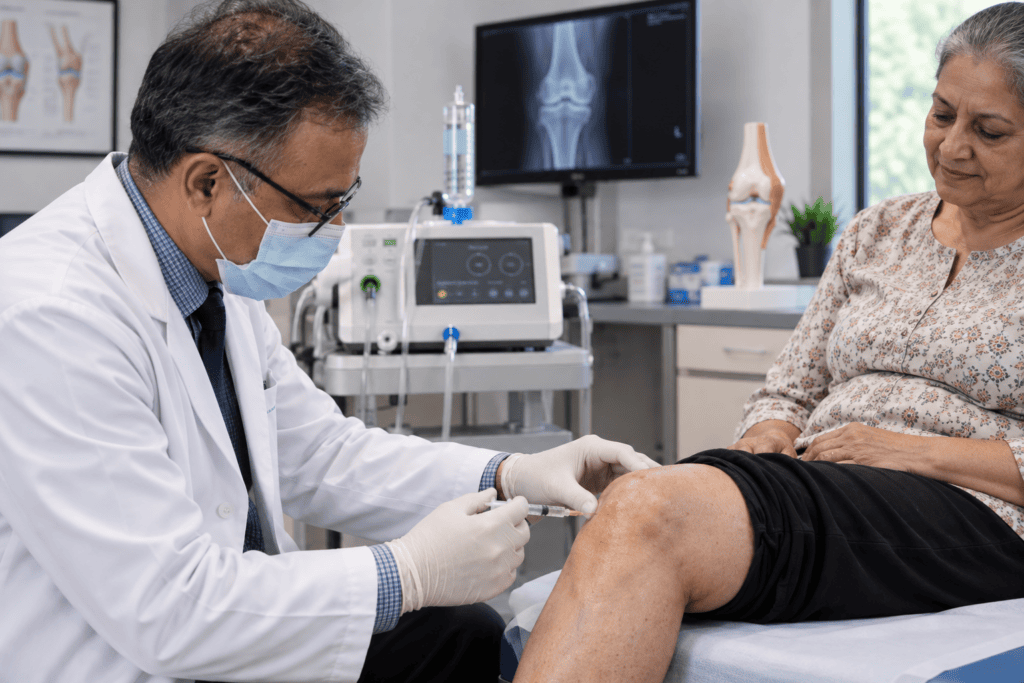
Oxygen-Ozone therapy involves injecting a controlled oxygen-ozone mixture into the knee joint. Ozone is a triatomic form of oxygen. When introduced into the joint in controlled therapeutic concentrations, it reacts with biological molecules and produces reactive oxygen species and lipid oxidation products. These reactions can stimulate the body’s own antioxidant and anti-inflammatory responses. The treatment is performed as an intra-articular injection using a sterile technique.
How Does Ozone Help?
Pain in an osteoarthritic knee is influenced by inflammation as well as mechanical changes. Inflammatory mediators such as IL-1, IL-6 and TNF-alpha are involved in the degenerative process, while oxidative stress and proteolytic enzymes can contribute to further cartilage damage. Ozone therapy is believed to act on this inflammatory environment. Studies have described effects on inflammatory cytokines, antioxidant enzymes and cellular metabolism. The treatment may also have an analgesic effect, helping reduce pain and stiffness and making movement and rehabilitation easier.
Clinical studies have reported improvement in pain, stiffness, function and quality of life after intra-articular ozone treatment.[1][2] Recent research has also examined how long these benefits are maintained after treatment.[3]
How Long Does the Effect Last?
The response to ozone is not the same in every patient. Some patients experience relief relatively early, whereas others improve gradually with treatment and rehabilitation. The published evidence suggests that the effect can be more pronounced in the short to medium term. [4][5] For this reason, we do not consider one injection to be the complete treatment of osteoarthritis. The patient’s activity, quadriceps strength, body weight, alignment and the condition of the joint continue to matter.
Ozone and Hyaluronic Acid
Hyaluronic Acid (HA) is naturally present in synovial fluid and contributes to the lubrication and viscoelasticity of the knee. It also provides shock-absorbing properties and has been studied extensively as a conservative treatment for knee osteoarthritis.
Ozone and HA act through different mechanisms. Ozone is used mainly for its anti-inflammatory and pain-modulating effects, whereas HA helps improve lubrication and the mechanical environment of the joint. Studies have directly compared ozone with HA, and research has also evaluated their use in combination. In the 2016 study by Giombini et al., patients receiving the combination of oxygen-ozone and HA showed better outcomes, particularly at the two-month follow-up, than patients receiving either treatment separately.[6] A more recent randomized trial comparing oxygen-ozone with HA found improvement in both groups, with comparable outcomes at six months and only mild, self-limiting adverse events reported.[5]
Oxygen-Ozone Therapy in the Ludhiana Protocol
At Dr. N. K. Aggarwal Joints & Spine Centre, Ludhiana, Oxygen-Ozone therapy is used as part of the Ludhiana Protocol for Multimodal Knee Preservation.
We generally combine different treatment modalities according to the condition of the individual knee. These may include High Molecular Weight Hyaluronic Acid, PRP/Growth Factor Concentrate, joint lavage, rehabilitation and correction of mechanical alignment. Ozone is therefore used as an adjuvant, not as a standalone answer to every case of osteoarthritis.
Who May Benefit?
The decision is made after assessing the patient’s symptoms, clinical examination, X-rays or MRI findings, severity of osteoarthritis, alignment and general health. Ozone has been studied particularly in mild to moderate knee osteoarthritis, including patients with Kellgren-Lawrence Grade I–III disease. The treatment is not suitable for everyone, particularly where there is severe structural damage, major deformity or a clear indication for knee replacement.
Certain medical conditions also need to be considered before treatment. Published clinical guidance lists pregnancy, significant G6PD deficiency, hyperthyroidism, thrombocytopenia, serious cardiovascular instability and active infection among important contraindications or precautions.
Medical References
[1] Lino VTS, Marinho DS, Rodrigues NCP, Andrade CAF. Efficacy and safety of ozone therapy for knee osteoarthritis: an umbrella review of systematic reviews. Front Physiol. 2024;15:1348028.
[2] Raeissadat SA, Rayegani SM, Forogh B, et al. Intra-articular ozone or hyaluronic acid injection: Which one is superior in patients with knee osteoarthritis? J Pain Res. 2018;11:111-117.
[3] Chen T, Tao D, Deng Z, et al. The time-effect relationship of intra-articular ozone injection for knee osteoarthritis: a systematic review and meta-analysis. 2026.
[4] Migliorini F, Giorgino R, Mazzoleni MG, et al. Intra-articular injections of ozone versus hyaluronic acid for knee osteoarthritis: a level I meta-analysis. Eur J Orthop Surg Traumatol. 2024;35:20.
[5] Sconza C, Parente A, Marotta N, et al. Intra-articular injections of oxygen-ozone versus hyaluronic acid for the treatment of knee osteoarthritis: A randomized controlled trial. J Back Musculoskelet Rehabil. 2026;39(1):216-227.
[6] Giombini A, Menotti F, Di Cesare A, et al. Comparison between intra-articular injection of hyaluronic acid, oxygen ozone, and the combination of both in the treatment of knee osteoarthrosis. J Biol Regul Homeost Agents. 2016;30(2):621-625.
- Category: Uncategorized